How Many Puzzle Pieces for Ages 3, 4 and 5? A Parent’s Guide
How many puzzle pieces should you choose for a 3-, 4- or 5-year-old? Start with the product’s age label, then consider the picture, piece size and your child’s experience. This guide helps you find an enjoyable starting point without turning play into a test.
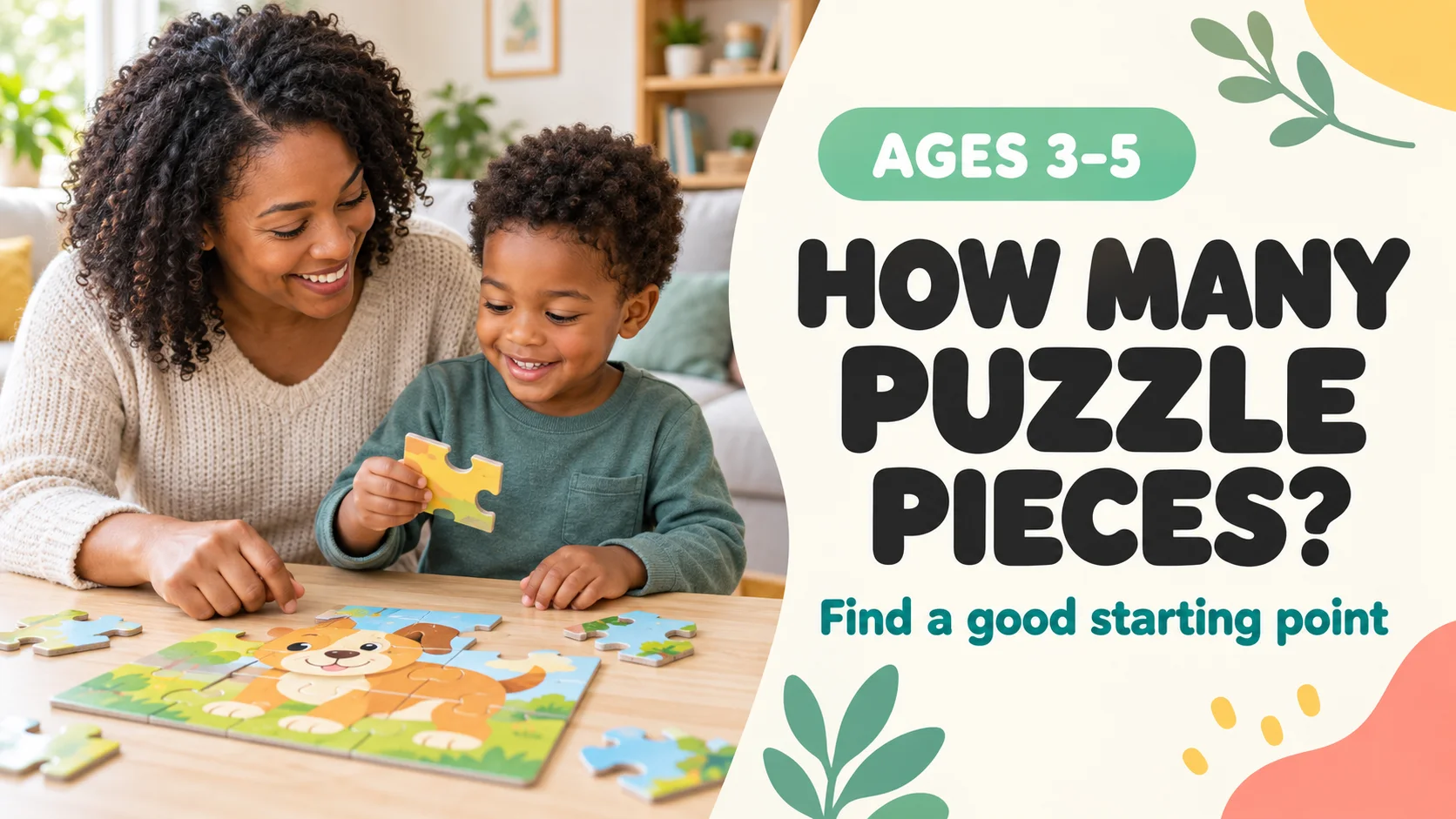
Published: . Information checked September 12, 2026. Written by 39Kids, the developer of PhotoPuzzle. Product age labels are shopping references, not developmental assessments. The cover is an AI-generated lifestyle illustration. Practical guidance was updated on October 7, 2026.
There is no single puzzle piece count that every 3-, 4- or 5-year-old should complete. Check the product’s age guidance first, then look for a slightly easy puzzle with a clear picture and pieces your child can handle.
If your child gets stuck before finishing, simplify the picture or count. If they finish and then leave, ending the session can be a success—not a sign that the next puzzle needs more pieces. Try the ideas in our bored-with-puzzles guide before increasing difficulty.
Below, you will find labeled product examples, practical ways to adjust difficulty and a way to change the count without changing the photo. If your main concern is that your child cannot get started, see our guide to helping a 3-year-old with puzzles.
How many pieces for ages 3, 4 and 5? Manufacturer examples
These examples from Ravensburger’s US website pair a specific product’s age label with its piece count. They are not averages, ability ranges or targets for every child of that age.
| Product age label | Pieces per puzzle | Official product example |
|---|---|---|
| 3+ | 12, 16, 20, 24 | Family Time: four puzzles with different counts |
| 4+ | 24 | Construction Site: a frame puzzle |
| 5+ | 49 | Digger at Work!: three puzzles, each with 49 pieces |
Checked September 12, 2026. Availability and labeling may vary by market; follow the actual package and safety instructions. A “3 × 49” set contains three separate 49-piece puzzles, not one 147-piece puzzle.
Age 3: a beginner can start below these counts
An ages-3+ puzzle can still feel difficult to a child who has never tried one. Choose an age-appropriate product with a few large pieces. Another option is to build most of the puzzle together and leave just one piece for your child to place.
Age 4: look beyond the number 24
A familiar picture and an unfamiliar one can offer different clues, even with the same count. Instead of buying a harder puzzle because of a birthday, notice whether your child looks for pieces independently and where they ask for help.
Age 5: let experience guide the next choice
A 49-piece product may be an option, not an obligation. A beginner can still start small. For a child who already enjoys puzzles, try a modest increase while keeping the picture style and piece shapes as familiar as possible.
Five things that change difficulty besides piece count
Finishing one 16-piece puzzle does not guarantee an easier time with every 12-piece puzzle. Compare these features before assuming the number is the problem.
- Picture: one large animal provides different clues from a scene filled with similar patches of sky or grass.
- Piece size and thickness: can your child pick up and move a piece without knocking its neighbors apart?
- Shape: distinctive outlines offer different clues from many similar-looking pieces.
- Frame and reference picture: a boundary or finished image can give you something to point to together.
- Familiarity: the subject, previous rounds and knowledge of the controls all affect the experience.
For example, a close-up of one red toy car lets you name the wheels and windows. If a photo of many tiny cars feels confusing, try a clearer picture before changing the count.
Choose a puzzle that fits your child today
Kumon Publishing’s official puzzle guide (Japanese) also recommends beginning a little below the child’s current level and progressing gradually. Here is a practical way to choose at home.
- 1. Check the age label and safety instructions
Start with products appropriate for your child’s age. If a younger sibling is nearby, plan where to play and how to keep small pieces out of their reach. - 2. Choose a favorite subject and manageable pieces
Let your child help choose an animal, vehicle or other familiar subject. Look for a picture they want to explore, not just a bigger number on the box. - 3. Begin together and notice how much help is needed
Place one piece as a demonstration, then pause. If you are deciding where almost every piece goes, try fewer pieces or leave only a small part of the puzzle unfinished.
These are play suggestions, not a test. You do not need to time a round or compare your child’s count with a sibling’s or friend’s.
When to try more—or fewer—pieces
Finishing once does not mean you must increase the difficulty. Offer a choice: the same puzzle again, a different picture or a few more pieces.
| What you notice | What to try | What you might say |
|---|---|---|
| Independently finding pieces and asking to play again | Repeat, or offer a small increase in count | “Same one, or a few more pieces?” |
| Getting stuck on similar-colored areas | Show the reference or find a distinctive detail | “Can you find the car’s wheel?” |
| Needing repeated help and becoming upset | Reduce the count or leave just one piece to place | “Shall we do this part together?” |
| Stopping and wanting another activity | Finish for now; keep the same count next time if useful | “We can stop here today.” |
Change one thing at a time. Changing the picture, shapes and count together makes it harder to tell what caused the difficulty. Keep a familiar puzzle available so that returning to it is always an option.
Try 4, 9, 16, 25 or 36 pieces with the same photo
A photo puzzle is one way to explore different counts before buying another puzzle. PhotoPuzzle, made by 39Kids, lets you use the same photo with 4, 9, 16, 25 or 36 pieces in Puzzle mode.
- 1. Pick one clear photo
Try a favorite toy or pet shown large in the frame. You can also use a built-in sample instead of a personal picture. - 2. Start with four pieces to try the controls
Open Pieces in Puzzle mode and select four pieces. This is our suggested first try, not an age-three developmental standard. - 3. If your child wants to continue, change only the count
The options run from 4 to 9, 16, 25 and 36; you do not have to work through them all. Keep the photo, shape and layout unchanged. Changing the count rebuilds the arrangement, so ask before changing a puzzle your child is working on.
See how to use PhotoPuzzle for the controls, or three ways to turn a photo into a puzzle for alternatives to an app. At the time of checking, the iPhone and iPad version is free, with no ads or in-app purchases. Check the App Store listing for current device requirements.
An app count is not a buying test for a physical puzzle. Picking up and turning a cardboard piece differs from moving one on a screen. PhotoPuzzle also helps pieces snap into the correct place when they are close. Completing 36 pieces in the app does not establish readiness for a physical puzzle with the same count.
Frequently asked questions about ages and puzzle pieces
How many puzzle pieces should a 3-year-old start with?
Some products labeled ages 3+ include puzzles with 12, 16, 20 and 24 pieces, but those counts will not suit every beginner. Choose an age-appropriate product with a few large pieces, or assemble most of a puzzle and invite your child to place the last piece. For a photo puzzle app, four pieces is our suggested first try—not a developmental standard.
Should I worry if my 4-year-old cannot do a 24-piece puzzle?
Completing a 24-piece puzzle is not, by itself, a way to judge development. The picture, shapes, frame, reference image and previous experience all affect the task. Try fewer pieces, a favorite subject or finding one piece together.
What piece count should I buy for a 5-year-old?
Manufacturer examples include 49-piece puzzles labeled ages 5+, but that is not a universal goal. A beginner can start with fewer pieces in an age-appropriate product. An experienced puzzler could try a small increase while keeping the picture style and piece shapes familiar.
Is it okay to repeat an easy puzzle?
Yes. If your child enjoys it, you do not need to make every round harder. Offer a choice of the same puzzle, a different picture or more pieces. Looking for the next piece independently is a useful cue for offering a new challenge; a finishing time is not required.
Does completing 36 pieces in an app mean my child can do a 36-piece cardboard puzzle?
Not necessarily. Moving a piece on a screen differs from picking up, turning and fitting a physical piece. Apps may also snap pieces into place. Choose a physical puzzle on its own merits, starting with a comfortable level.
How many pieces does PhotoPuzzle offer?
PhotoPuzzle’s Puzzle mode offers 4, 9, 16, 25 and 36 pieces. You can keep the same photo while changing the count, although changing the setting rebuilds the arrangement. There is no need to complete all five levels; choose the count your child wants to play today.
Focus on the next piece, not the age target
An age label is a starting point for choosing a product. Look beyond the count to a favorite picture, manageable pieces and helpful references, then begin a little easier than you think you need to.
Offer more pieces when your child wants another challenge, fewer when it feels frustrating and a break when they want to stop. The goal is an enjoyable puzzle together—not a number your child has to reach by a birthday.
PhotoPuzzle
Turn a favorite photo into a 4–36-piece puzzle. Keep the picture and change the count to find a comfortable challenge together.