Child Bored With Puzzles? 7 Ways to Make Play Feel Fresh Again
“My child can finish a puzzle, but never wants a second round.” Before buying another box or adding pieces, consider what part of the activity your child enjoyed. These seven small changes can make the next invitation feel different without turning play into a task.
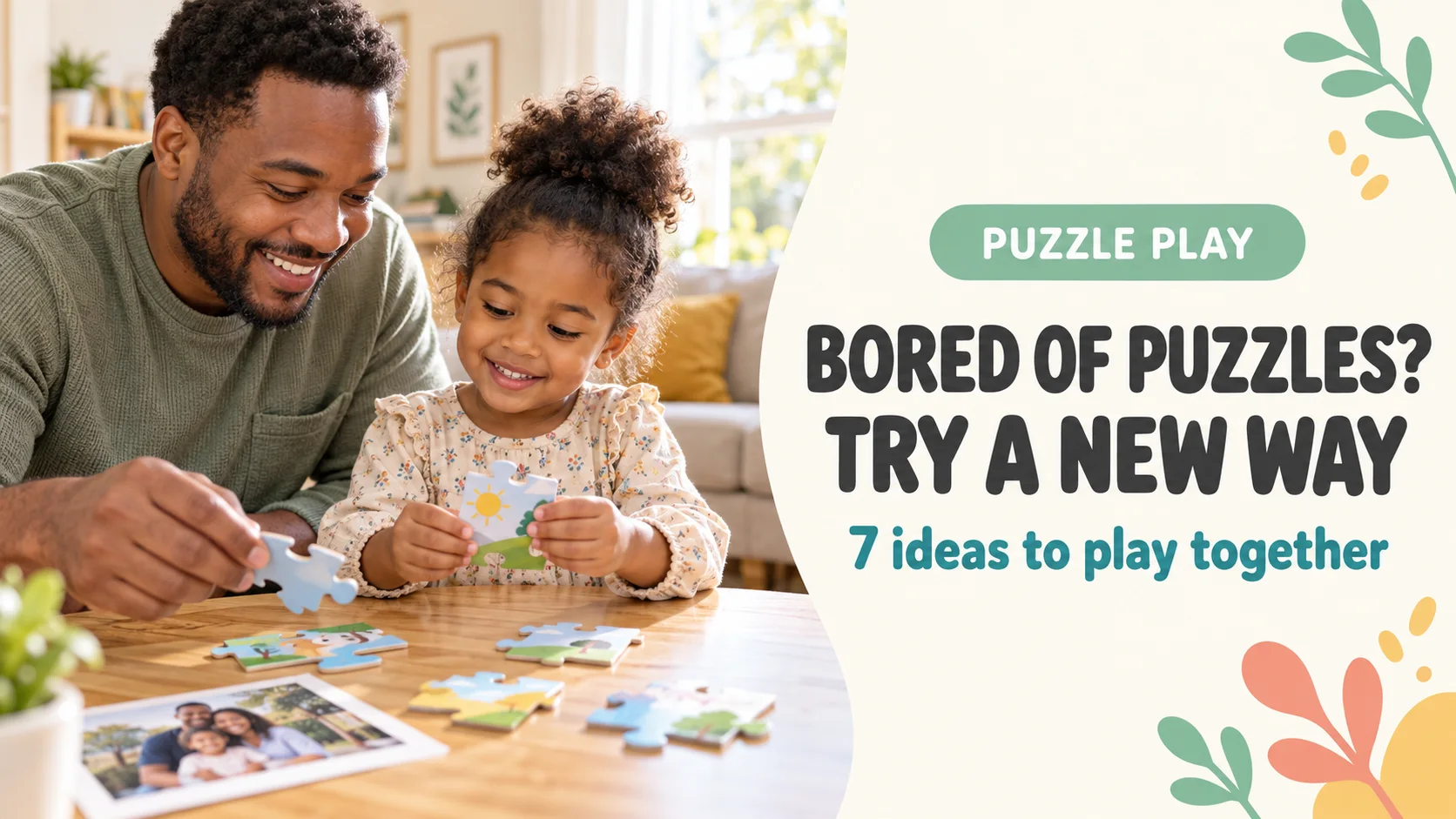
Published and information checked: . Written by 39Kids, the developer of PhotoPuzzle. Children’s interests and playtimes vary. These are family play ideas, not a developmental assessment. The cover is an AI-generated illustration of the topic. Practical guidance was updated on October 7, 2026.
If your child can finish a puzzle but does not want to repeat it, change the reason to come back rather than only making it harder. Let them pick a picture, alternate turns, or tell the story behind a family photo. Those small changes make a new round possible without adding pieces.
First notice whether they dislike the picture before starting, get stuck halfway, or simply feel finished after a complete round. In the last case, stop without pressing for another puzzle; offer a child-chosen photo on a different day.
If finishing a puzzle is still the hard part, see our guide for children who struggle with puzzles. For piece counts and age labels, read our puzzle difficulty guide. This article is about interest fading after a child has managed a puzzle.
The short answer: change the invitation, not just the difficulty
Not wanting another round after finishing one puzzle is not, by itself, a problem. A child may be satisfied with the picture or simply interested in something else today. Instead of trying to stretch the session, offer one small change your child can choose.
- Picture feels familiar: swap in a favorite person, toy or vehicle.
- Challenge feels off: move one step up or down in piece count.
- Solo play is not appealing: take turns placing one piece each.
- Today is for something else: stop and try again another day.
The National Association for the Education of Young Children (NAEYC) describes guided play as keeping children’s initiative while adults offer support. Treat the ideas below as options, not a program every child must follow.
Notice when your child leaves the activity
| What you notice | A first thing to try |
|---|---|
| They stop after finishing | Call the round complete; offer a different photo next time |
| They pause halfway | Show the example or place the first piece together |
| They avoid this picture | Let them choose a favorite subject |
| They move to another game | Do not pull them back; invite them another day |
This is not a diagnostic chart. Tiredness, setting and mood can change a play session. Use the moment you notice as a clue for your next invitation, not a reason to question your child about why they are bored.
Seven ways to make a puzzle feel fresh again
1. Let a finished round be the end
“You did it; we can stop here” leaves room for another day. Avoid making a second round the price of praise. If your child wants to stop before finishing, that is okay too.
2. Offer two or three photos to choose from
A family face, a favorite stuffed animal or a train can be more inviting than a picture an adult picked. Give a small choice rather than the entire camera roll. A digital photo puzzle lets you change artwork without buying another box. A toy or pet photo works if you do not want to use a face.
3. Change one difficulty setting at a time
If the current puzzle ends too quickly, try one more level of pieces with the same picture. If your child stalls, step back. Keeping the photo constant makes it easier to tell whether the new piece count fits. More pieces are not a goal in themselves.
4. Look at the example and start together
Looking at the completed image is a useful clue, not cheating. Point out a color or shape, place the first piece together, and hand the next choice back to your child. NAEYC’s family guidance includes completing a puzzle together as a shared activity.
5. Take turns instead of racing
Try one piece each, asking “Which color should we look for next?” rather than timing the finish. Let your child explain their clue before you supply an answer. If siblings join, agree on turns before play begins.
6. Talk about the photo before moving pieces
“Where were we?” or “Who took this?” adds a memory to the picture. It need not be a quiz with right answers. If your child wants to look at the photo and talk rather than complete the puzzle, that can be the whole activity.
7. Put the puzzle away for now
Switch to blocks, outdoor play or a paper puzzle when your child wants something else. On another day, PhotoPuzzle also offers a cube mode using a chosen photo. Try that mode yourself before handing over the device.
Try “choose a new picture” in PhotoPuzzle
PhotoPuzzle from 39Kids is an iPhone and iPad app that can use a device photo or an included sample. The App Store listing describes five piece counts: 4, 9, 16, 25 and 36. Start with one picture your child likes and four pieces.
- 1. Choose a photo
Use the app’s photo button to pick a device image or sample. Let your child choose from a few prepared options. - 2. Set four pieces
If your child wants another round with the same photo, then offer nine pieces or another level. - 3. Ask what they want next
“Again, a different picture, or all done?” gives them a simple ending choice.
For the exact controls, see our PhotoPuzzle how-to guide. For choosing piece counts, use our piece-count guide. PhotoPuzzle for Android is still coming soon as of October 3, 2026.
Keep the next chance to play low-pressure
“You always get bored” or “Other kids can do more” turns play into a comparison. Repeated races can do the same. If interest fades, finish for now and change one thing next time: the picture, time of day or person playing alongside them.
Before sharing a phone, also review photo permissions, purchase prompts and the app your child can reach. Our guides to using children’s photos in apps and locking a phone to one app cover those separate checks.
Questions about a child getting bored with puzzles
Is it okay if my child stops after completing a puzzle once?
Yes. Your child may simply be satisfied with that round. Notice whether the picture, challenge or timing seems to matter, then end the activity comfortably. Offer a different photo or way to play another day if they seem interested.
Should I add more pieces whenever my child gets bored?
Not automatically. A harder puzzle can be a welcome change if the current one is too easy, but it can also feel like extra work. Try changing the picture, taking turns or pausing first. Adjust pieces based on what your child actually does.
Can we keep using the same photo?
Of course. Some children enjoy repeating a familiar picture; others want a new one. Offer two or three possible photos and let your child choose. Repeating an image is not a problem that needs fixing.
How do I tell boredom from finding the puzzle too difficult?
Look at the moment your child leaves: before starting, halfway through, or just after completion. If they pause halfway, try showing the example or placing the first piece together. If completing the puzzle is the main difficulty, our separate guide on children struggling with puzzles may help.
Is PhotoPuzzle free, and is it available on Android?
As checked on October 3, 2026, PhotoPuzzle is free for iPhone and iPad, with no ads or in-app purchases. The Android version is coming soon. Check the current App Store listing before installing.
What if I do not want to use a photo of my child?
You can use a photo of a toy, pet or drawing, or choose one of PhotoPuzzle’s sample pictures. Before using family photos, review device photo permissions, the app’s photo handling and your device’s separate cloud-sync settings.
Takeaway: let them choose the next picture
A child who appears bored with a puzzle does not automatically need a harder one. Change the photo, roles or timing one at a time, and leave room for your child’s choice. It is fine to stop today and choose another familiar picture together when they want to play again.
PhotoPuzzle
Swap pictures and start with four pieces. Free for iPhone and iPad; Android is coming soon.